 The 3·30·9 Plan. Your affairs in order, in one afternoon.
Get your affairs in order in one afternoon.
So your family never has to guess, hunt or fight.
The bank can freeze the account the day it hears. The bills keep coming. Survivor benefits only start when somebody applies. The Legacy Ready Kit is the step-by-step plan for that part: what to do, who to call and in what order, across the first 3 days, 30 days and 9 months. Written for how it works here: Social Security, Medicare, the banks, the 401(k) and IRA forms, your state's probate court.
Get the kit →- A plan for the 3 windows that matter, plus the fill-in records that feed it. No legal jargon.
- Every step tied to an official source: SSA, IRS, CFPB, FTC, VA and state law.
- Nothing uploaded. No account, no login, no cloud. We never see a word you write.
- Instant email delivery. Fill it in on screen or print it at home, start this evening.
- One payment, once. Nothing renews, nothing to re-buy.

Do it once, one afternoon. Then stop thinking about it.
Your family has the plan for life. Sit down once, fill it in, and it's handled: they know where everything is, who to call and what to do first. One flat price, paid once.
If it's not for you, you get every cent back. One email, no forms, nothing to send back.
When you're gone, the paperwork doesn't stop. It lands on the people you love.
Between the day someone dies and the day the estate is finally closed, there's a stretch of work no one prepares you for. It has an official name: estate administration. Here's what it actually looks like.

The scavenger hunt
Your kids going drawer by drawer, through old statements and a locked phone, trying to work out which banks, which retirement plans and which policies even exist.
Nobody notifies anybody
There's no one place to report a death. The funeral home usually tells Social Security, and Social Security tells Medicare. That's it. Banks, insurers, plan custodians, the DMV, utilities, subscriptions: your family calls every one of them, one at a time.
Money frozen, bills still coming
An account in one name can be frozen once the bank is told, until someone has authority from the court or your state's small-estate process. The automatic payments from it can stop. The mortgage, the utilities and the insurance keep arriving.
One form beat a divorce decree. The Supreme Court agreed, 9 to 0.
He named his wife on his retirement plan form. They divorced, and the decree said she gave up her claim. He never changed the form. When he died, the plan paid her about $400,000, and the Supreme Court said the plan was right to do it. Your will has no say over a 401(k), an IRA, a life insurance policy or a payable-on-death account either. The form on file does.
Kennedy v. Plan Administrator for DuPont Savings and Investment Plan, 555 U.S. 285 (2009)Nobody sends a bill for “we didn't know.” It gets paid anyway.
Three of the ways it gets paid, with the rules behind them.
The money nobody applied for
The Social Security death payment is never sent automatically: it must be claimed within 2 years. Survivor benefits start when someone applies, and back payments are limited. Every month of waiting can be money gone for good.
SSA, Lump-sum death payment · 20 CFR §404.621The house that loses its insurance
Many home insurance policies limit or drop coverage once a house sits empty for 30 to 60 days, while the mortgage, the taxes and the utilities keep running. One phone call prevents it, if someone knows to make it.
Standard homeowners vacancy clauses; check your own policyThe account nobody knew existed
About one American in seven has unclaimed property sitting with a state: forgotten accounts, unpaid life insurance, final paychecks. States returned more than $4.49 billion to owners in a single year. The rest waits for someone who knows to ask.
NAUPA, unclaimed.org · FY2024Illustrative, not a promise: the kit doesn't file a claim or replace an attorney. It makes sure your family knows what exists, and what to do first.
“They'll figure it out, right?”
They would, eventually. Over many stressful months, with frozen accounts, missed windows and forgotten policies along the way. And it won't be split evenly: it lands on one person, usually a daughter, who learns the job while doing it, while grieving. They don't just need your information. They need a plan: what to do, who to call, and in what order.
One method that covers everything that happens after a death. Done once.
Three clocks start the day someone dies, and almost nobody knows them in advance. The 3·30·9 Plan puts every step in its window, in order, each one tied to a federal rule, a state rule or the way an institution actually works.
The first 3 days
The first moves, in order: a doctor or 911, then the funeral home (your rights under the FTC Funeral Rule, and the details they'll ask for), at least ten certified death certificates, the original will, the house and the mail, and the last benefit payment left untouched.
The first 30 days
There is no single place to report a death. Every bank's estate team, the mortgage, the insurers, the 401(k) and IRA custodians, the VA if they served, the three credit bureaus, the utilities and the subscriptions: one call at a time. The $255 payment and survivor benefits have to be claimed.
The first 9 months
The empty house and its insurance. Your state's small-estate process or probate court. The debts, which belong to the estate, not the children. The final tax return. And one federal deadline with no extension: nine months to refuse any part of an inheritance.
The three windows are federal or practical, so they hold in all fifty states. What changes state to state is on Your State Quick Sheet.
Why it's the last method you'll need
It covers the whole path.
From the first phone call to the day the estate closes. Not a piece of it.
Every step is sourced.
Social Security, the IRS, the CFPB, the FTC, the VA, federal regulations and state law. Nothing is somebody's opinion.
It's built to be finished.
Prompts instead of blank pages. One afternoon, one folder, done.
You pay for it once.
Attorneys bill by the hour. Planners bill by the year. This is one payment, and it doesn't come back.

Two things in one kit: the plan, and the records that feed it.
Every page is written for how it works in the United States, so nothing important is left out.
The step-by-step guide: The 3·30·9 Plan. Window by window: what to do, who to call, what to say and in what order, with a checkbox for every step, call scripts, the seven mistakes that cost families money, and the official source for every rule.
The Family Record. Twelve guided sections, 574 fill-in fields, prompts instead of blank pages: about me, key contacts, health, bank accounts, retirement and beneficiaries, income, insurance, the home, debts, automatic payments, digital life, and where everything is kept.
Start Here. The first five steps, in order, for whoever opens the folder, plus a wallet card that says where it's kept.
Your State Quick Sheet. What changes in your state, which states have their own estate or inheritance tax, and the exact questions that get your county court's answers in one call.
Find the money nobody knows about. Where to look for forgotten accounts, old 401(k)s and lost life insurance, including the free NAIC policy locator and MissingMoney.com.
If they served. Where the DD-214 is kept, VA burial benefits, and the one-year rule for survivor compensation, written into the plan.
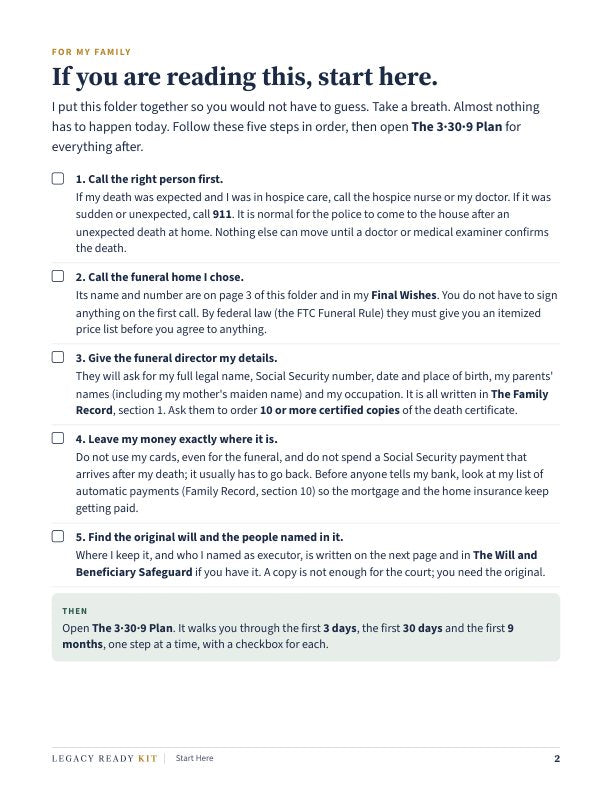
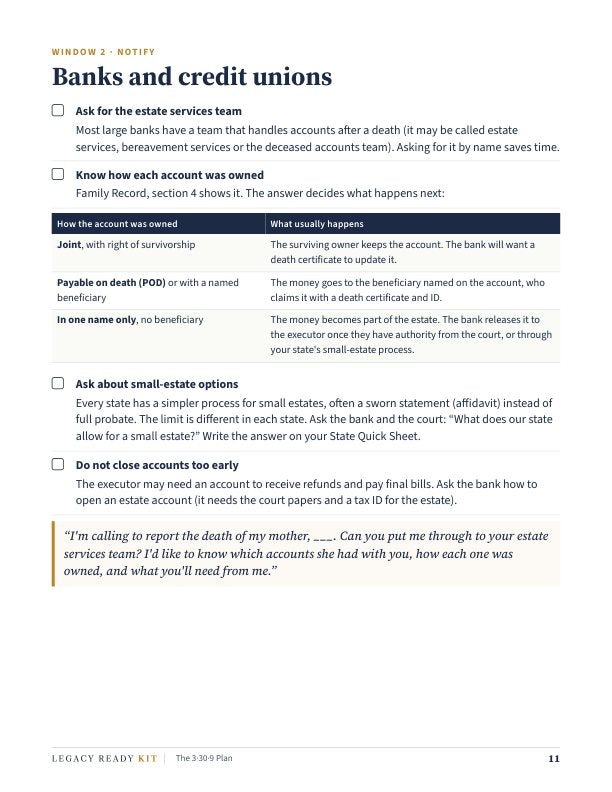
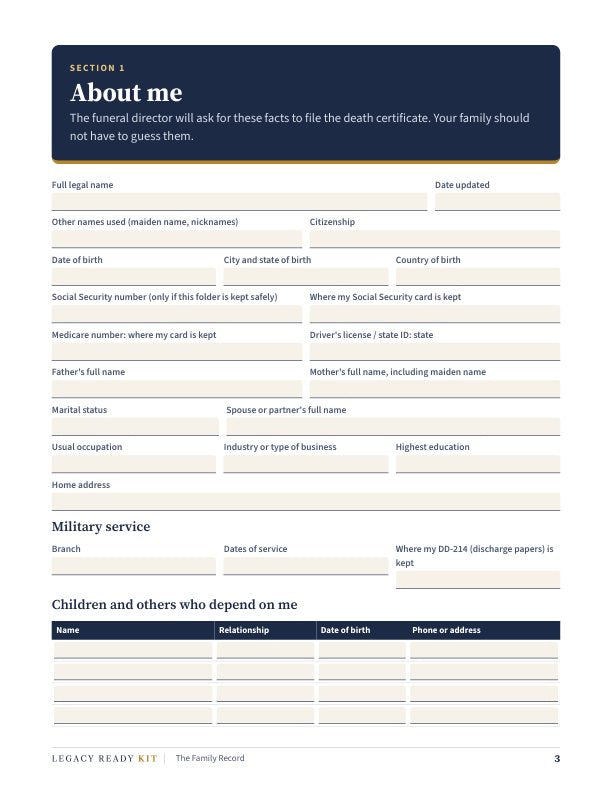
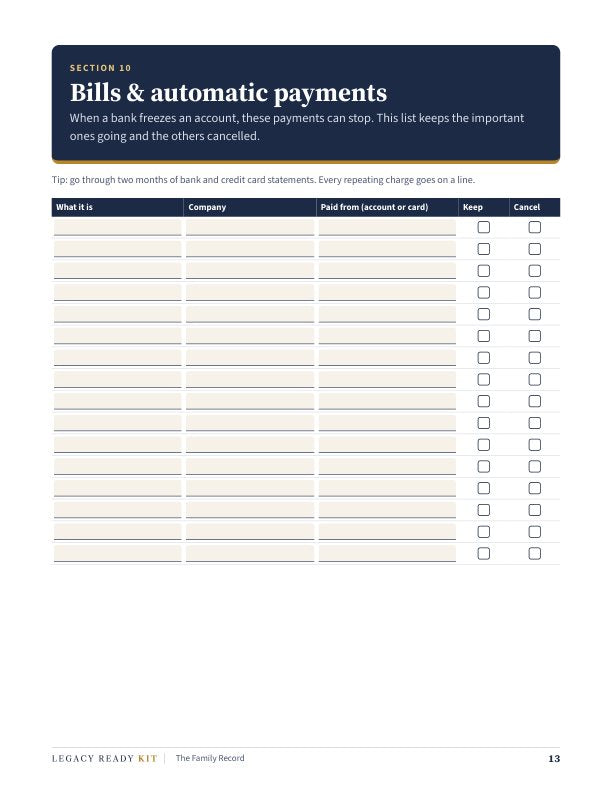
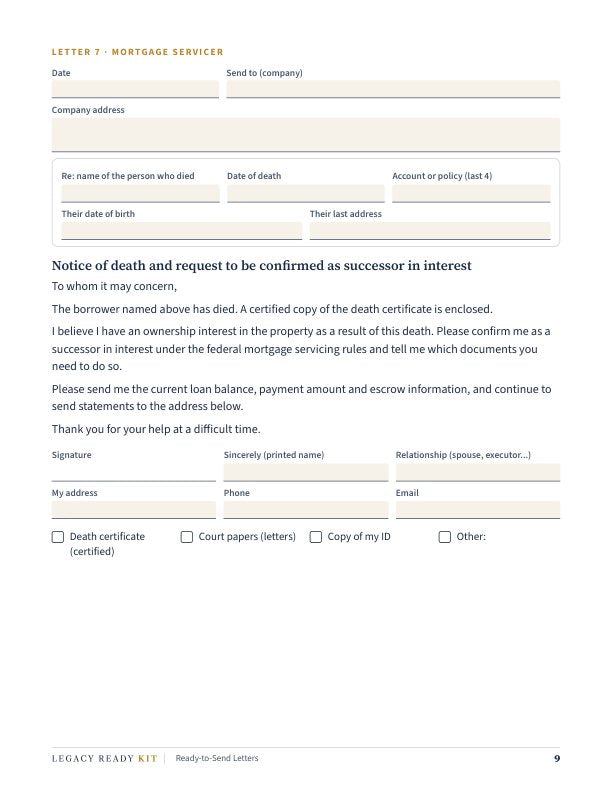

Delivered instantly by email · printed at home or filled in on screen · kept in one folder.
A blank notebook says where things are. It doesn't say what to do.
The alternative in most people's minds isn't an attorney. It's the notebook from the big-box store, or the free checklist that never got filled in. Here's what each one actually does.
| What it does | Blank notebook | Free checklist | Online planner | Estate attorney | Legacy Ready Kit |
|---|---|---|---|---|---|
| Where things are kept | ✓ | ~ | ✓ | ✕ | ✓ |
| What to do, in what order, with the deadlines | ✕ | ~ | ~ | ~ | ✓ |
| Who to call and what to say | ✕ | ~ | ~ | ✕ | ✓ |
| Ready-to-send notification letters | ✕ | ✕ | ~ | ✕ | ✓ |
| Nothing uploaded, no account, no login | ✓ | ✓ | ✕ | ✓ | ✓ |
| One payment, nothing renews | ✓ | free | ✕ | ✕ | ✓ |
| Built to actually get finished | ✕ | ✕ | ~ | ✕ | ✓ |
✓ yes · ~ in part · ✕ no. The attorney column isn't a knock: drafting your will or trust is their job. Telling your family what to do the week after is not.
You do it once, calmly, over a single afternoon.
Guided questions and clear sections. No blank-page overwhelm, no jargon, no legal training required. Fill it in at your own pace, on paper or on screen, and keep it together.
Plain-English prompts
Every line tells you exactly what to put there, and what to skip if it doesn't apply.
References, never secrets
Institutions, the last 4 digits and where things are kept. Never passwords, never PINs.
On screen or on paper
Type into every blank on a computer, tablet or phone, or print the pages and write by hand.


What families say after filling it in
A clear guide for the weeks after a death
“A clear guide to what actually happens after someone dies. How many certified death certificates will you need? Far more than I would have guessed. What to do first, what can wait, and in which week. Then the Family Record, where you write down everything the family will need to contact: pensions, life insurance, the bank and so on. Brilliant. I wouldn't have thought of half of it on my own.”

I'd give it six stars if I could
“Without this folder, I can picture how long and miserable it would be for our kids when the time comes. For starters, they'd have no idea how to get into anything on my computer. […] It's a well thought-out, safe system: no passwords written down, just where to find them. It gives our children a real head start on settling things and leaves them no way to miss anything.”

Don't hesitate. You won't regret it.
“The download link was in my inbox within a minute, and it printed out easily straight into my own binder […] Now I know that if something happened to me, our daughter would know where to look and exactly what to do first. Thank you for putting this together and giving us peace of mind at a fair price, with a real person answering whenever I had a question!”

A really well-made kit
“A really well-made kit. The instructions are clearly written and easy to follow, and the support is first-rate. The couple of questions I emailed were answered quickly and plainly, and nobody made me feel silly for asking. (Thank you, Daniel.) I'd recommend this kit to anyone.”

Eye-opening
“After going through the kit, I'm amazed at how little I actually knew. These are things you need to know before it happens, not after. I'd recommend both the kit and the Executor's Brief that comes with it.”

Worth every dollar
“The kit covers so many different things that have to be dealt with when someone passes. I've found it works best to do a few pages each evening, and I still haven't reached the end. I will, though, and I'll rest easier knowing everything is ready ahead of time.”

Organized and to the point
“I found this kit through an article I was reading online. I'd been meaning to get my paperwork in order for years, and this gives me a sensible, orderly way to finally do it. I've only just started, but so far it's easy to read and easy to follow.”

Simple to follow
“Everything is laid out in a sensible order. I know this is going to be a huge help to my kids. Thank you very much.”

Fast, and easy even for me
“The email arrived right away. Printing the pages was simple, even for a 78-year-old who usually can't stand computers!”

When the day comes, there are two versions of it.
Without a plan
- Drawers emptied onto the bed, hunting for accounts no one knew existed
- The death re-explained on call after call, in no order
- A forgotten policy or an old IRA found years too late
- The account frozen while the bills keep coming
- Survivor benefits claimed late, because nobody knew the clock
- Probate stalled over one missing document
- Funeral wishes argued over, because no one was sure
- Grief, with paperwork piled on top
With the Legacy Ready Kit
- Every account, plan and policy already listed
- A clear order of who to call, and what to have in hand
- Nothing valuable quietly lost
- The right steps taken in the right weeks
- Claims filed while they still count
- Papers for the attorney ready, in order
- Funeral wishes written down, clearly
- No one left guessing, no one left blamed
You'll be the one holding the folder. Start it now, together.
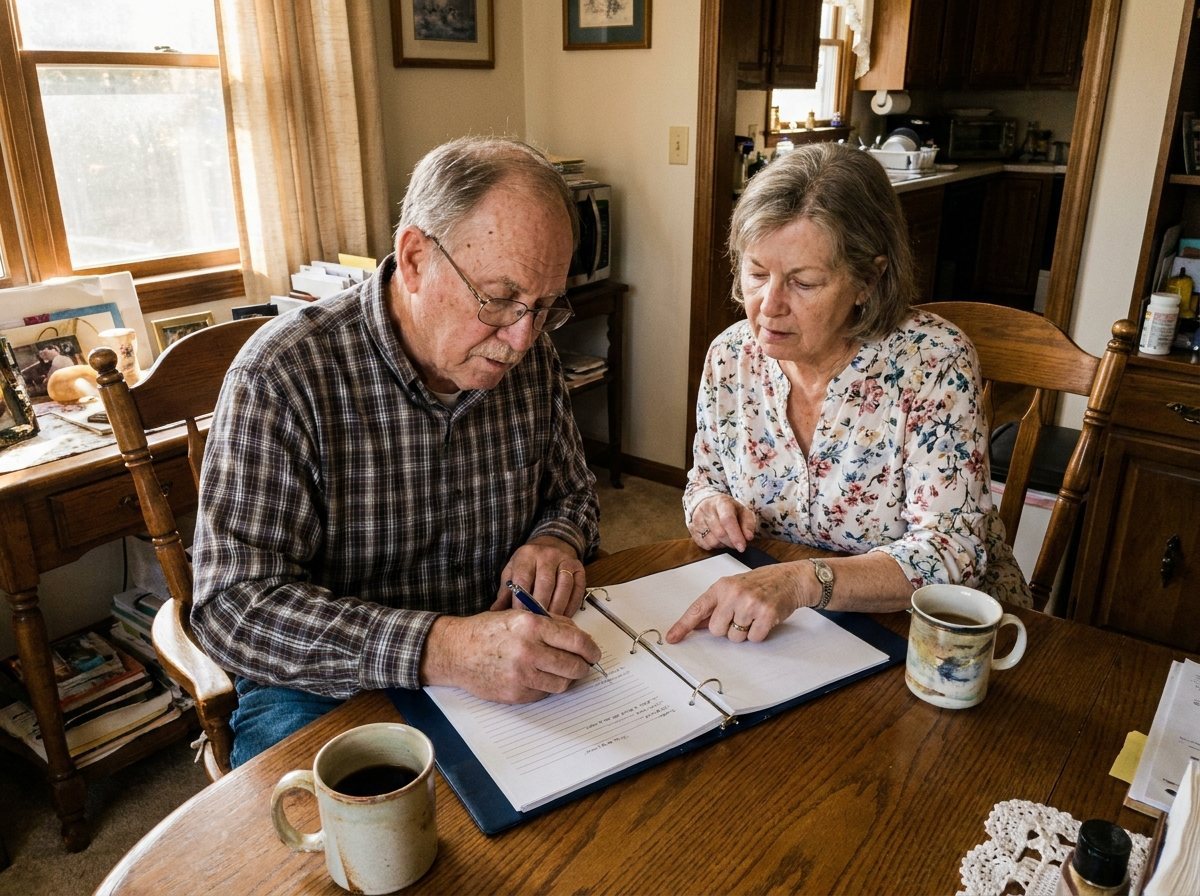
Many of the people who buy this kit are the daughter or son who'll be the executor. Order it in your name. It arrives by email in minutes. Print it, bring it over for Sunday dinner, and fill it in together, one page at a time. Nothing in it asks how much anything is worth.
That sentence opens the conversation. The Start Here page does the rest. And if you have brothers and sisters, print a copy for each of them: the ones who know the plan are the ones who don't fight over it.
One payment. One afternoon. A long, hard problem, handled before it starts.
Frozen accounts, dozens of phone calls, benefits that have to be claimed, a house that can quietly lose its insurance. That is the size of the problem. The Legacy Ready Kit is one payment, the price on this page, and it covers the entire path. Nothing renews. Done once, kept forever.
One payment. Three levels of preparation.
Every kit is the full 3·30·9 Plan with the Family Record, paid once, delivered by email to fill in on screen or print at home, with a 30-day money-back guarantee. Nobody calls you, and nobody asks what your accounts are worth.
Every kit: printable and fillable PDF · instant email delivery · 30-day money-back guarantee. Nothing is shipped.
A simple 30-day money-back guarantee
Download the kit, read the plan, print the pages and start filling them in at your own pace. If you don't feel it helps your family know what to do, email us within 30 days and you get every dollar back. Nothing to send back, no forms, no questions, no phone call to sit through.
Estate attorneys bill by the hour, and they should: drafting a will or a trust is real legal work. This kit doesn't replace any of that, and it doesn't try to. It's the part they don't do: telling your family what to do, in what order, and where everything is. And it's the part that keeps the meter from running while your kids search.
And yes, free checklists are everywhere. You've probably downloaded one. The honest question is whether it's filled in. A blank binder helps nobody. This one is guided line by line, so it actually gets finished.
Only one person can fill this in. And only while they still can.
The afternoon to do this is the one you still have, with your memory, your handwriting and your say. Nobody else knows where you keep things. When in doubt, take the Complete Kit: $89 once, and your family has the plan, the house, the letters, the executor's brief and the calendar, all in one folder.
Everything you might be wondering
Is this just a place to write things down?
No, and that's the whole point. Free checklists are everywhere; the honest question is whether one ever got filled in. This is a step-by-step plan, what to do, who to call and in what order across the first 3 days, 30 days and 9 months, with guided fill-in pages that feed it. You answer prompts. You don't design anything.
We already have a will. Do we still need this?
A will says who inherits. It doesn't list your accounts, your automatic payments, who is named on your insurance and retirement accounts, or who to call first, and it's often read weeks after those calls happen. The kit sits next to your will and covers all of it.
We already have a living trust.
Your successor trustee still needs to know what's in the trust and what's outside it (retirement accounts, life insurance, joint accounts), where the papers are, and the Social Security, bank and tax steps. The kit gives them all of it.
Is it safe to write all this down?
The kit asks for references, not secrets: the institution and the last 4 digits, never a full account number, password or PIN. For passwords, you write only where your password book or manager is kept.
Is anything stored online?
No. You download PDF files to your own computer, tablet or phone. What you type stays in your file. We never see it.
I don't have a printer.
You don't need one. Every blank is a fillable field you can type into on screen and save.
Can I fill it in on screen?
Yes. Use the free Adobe Acrobat Reader on a computer, tablet or phone, or the Files app on an iPhone. Type, save, and come back any time.
Can I buy it for my parents?
Yes, and many people do. Order in your name; the download link comes to you. Print it and fill it in together, or send them the files.
Doesn't Social Security take care of telling everyone?
No. The funeral home usually reports the death to Social Security, and Social Security informs Medicare. Banks, insurers, retirement plans, the credit bureaus, the DMV and every other company must be told separately. The kit lists them in order and includes the letters.
How long does all of this actually take?
Filling in the important pages usually takes one afternoon. You can add details later as statements arrive.
Does it work in my state?
Yes. Social Security, Medicare, the VA and the IRS follow the same rules in every state, and the plan is built around them. For what changes by state (the probate court, the small-estate limit, creditor deadlines, state taxes), Your State Quick Sheet shows what to look for and the exact questions to ask your county court.
Is this another subscription that'll bill me every year?
No. One payment. Nothing renews, nothing to re-buy.
We're not wealthy. Is this really for us?
Especially. Large estates usually have advisors. Ordinary families have a bank account, a house, a pension and a life policy, and that's exactly what this kit is built for.
Is this legal advice?
No. It's a practical plan and organizer based on official sources. It doesn't replace a will or an attorney; it helps your family arrive with everything in hand.
Isn't this a bit morbid?
Most people say the opposite: once it's done, they stop worrying about it. It isn't about dying. It's about the people you love having one less hard thing to do.
You worked hard for what you have. Don't let the last thing you leave be a scavenger hunt.
Pay once. Do it once. Be the one who left a plan.
Leave them a plan →